
Back in December 2021, I wrote a three-part series about memorized decks. If you've been following my blog for a while, you might remember these:
That last post explored several different approaches to memorizing a deck, from mnemonic systems and silly songs to good old-fashioned flashcards.
And if there's one thing all those methods have in common, it's repetition. Lots and lots of repetition.
I even talked about some of the digital tools available to help with the process. Well, nearly five years later, I decided it was time to make one of my own!
Introducing the Stack Trainer!
I've put together a new, completely free tool right here on The Babbit's Grimoire:
Whether you're just starting to learn your first memorized deck or you've already got Mnemonica down and want to sharpen your recall, the Stack Trainer is designed to help you practice.
No downloads, no accounts, no subscriptions. Just open the page, pick your stack, and start practicing.
Oh, and your progress is saved locally in your browser, so you can pick up where you left off on the same device. That's important to note though, since it's only on the "same device", your progress won't sync between your phone + computer.
Choose Your Stack
I've included three stacks to get things started:
- Mnemonica, by Juan Tamariz
- Aronson Stack, by Simon Aronson
- Si Stebbins, the classic sequential stack
These are some of the stacks I discussed in my original articles, and they're a great place to start. But, if you're interested in learning something else like your own stack or a different published one... no problem! You can enter your own custom 52-card stack, and the trainer will let you practice that one too.
Practice Makes Perfect (Or at Least Faster)
The whole point of a memorized deck is being able to recall any card's position, or the card at any position, without having to mentally count through the entire deck. You want to know it instantly.
Of course, getting to that point takes practice and that's where the trainer comes in.
I've included a handful of different ways to practice:
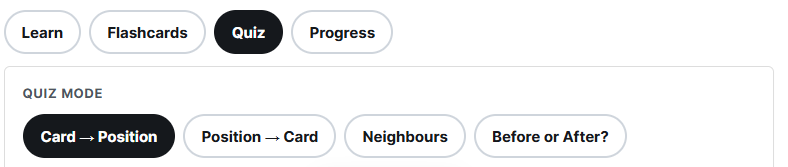
- Learn: Work through the deck in smaller chunks, one quarter (13 cards) at a time. There's no reason to tackle all 52 cards on day one.
- Flashcards: Practice both directions, card to position and position to card.
- Quizzes: Test yourself on card positions, identify cards at specific positions, or figure out which cards come immediately before or after another card.
- Neighbors: Practice identifying the cards on either side of a given card.
- Before or After: Similar to "Neighbors", but helps with speed-recall identifying the card immediately before or after it in the stack.
- Si Stebbins Rule Drill: Practice the underlying pattern that makes Si Stebbins work.
And because we all have those few cards that just refuse to stick in our heads, I've also added a "Weak Cards" mode. The trainer will keep track of the cards you're struggling with, allowing you to focus your practice on the ones that need the most attention.
You can view your accuracy, current streak, best streak, and individual card performance. It's a nice way to see how you're progressing rather than just hoping you've gotten better.
A Little at a Time
One of the things I mentioned in my original article was how difficult it can be to find an hour to sit down and memorize a deck. Between work, family, and everything else going on, dedicating a solid hour to singing the Mnemonica stack to yourself isn't always realistic.
And, let's be fair, your family might appreciate you not doing that.
That's another reason I wanted to build this. You can practice just a portion of the deck, whether that's the first 13 cards, the last 13 cards, or any range you want to work on.
Spend five minutes practicing over your morning coffee, run through a few flashcards during a break, or even quiz yourself on the cards you keep forgetting. The idea isn't to replace whatever memorization system you're using. It's to make the repetition part of learning a stack a little more convenient.
One Important Note
I designed the Stack Trainer to help learn and practice the order of a deck, not to teach memorized-deck magic. And there's a lot more to memorized-deck magic than remembering which card is at position 27.
If you're interested in what you can actually do with a memorized deck, I highly recommend checking out Mnemonica by Juan Tamariz, A Stack to Remember and Bound to Please by Simon Aronson, along with the many wonderful resources available on Si Stebbins.
There is a tremendous amount of fantastic magic in those books, and this little trainer isn't intended to replace any of it.
Give it a Try!
So, whether you've been using a memorized deck for years or you've been putting off learning one because memorizing 52 cards sounds like a nightmare, I hope you'll give the trainer a try.
Again, it's free, works right in your browser, and you can start with as little as 13 cards.
I've been using it for a couple weeks now and I have noticed a considerable improvement in my recall accuracy and speed; I can't believe I haven't tried making this sooner.
And, since this is a new tool, I'd genuinely love to hear what you think! If you find a bug, have an idea for another practice mode, or think there's something I could improve, please let me know. After all, I built this to help make practicing a little easier, and there's always room to make it better.
Now go memorize some cards!


